
Every publisher using AI to help with content has the same quiet fear at the back of their mind: one morning I’ll wake up, my rankings will be gone, and maybe AdSense will pull the plug too — all because a machine helped me write.
It’s a reasonable worry. There’s a lot of scary, contradictory advice out there. One blog swears AI content is perfectly fine; the next warns it’ll get your whole site nuked. So let’s cut through it with what Google actually says, what it actually does, and — the part most articles skip — what any of this means for the ad revenue your site depends on. No hype, no fear-mongering.
The short answer
Google does not penalise content for being written by AI. It penalises low-quality, thin, mass-produced content — no matter who or what created it. AI-assisted content that’s genuinely helpful, accurate, and edited by a real human can rank just fine and keep your ad revenue safe. AI content that’s cranked out by the hundred with no review is what gets sites into trouble.
That’s the whole thing in a paragraph. But the details matter, because “just make it good” is easy to say and easy to get wrong. Here’s what’s really going on.
What Google actually says (in its own words)
This isn’t guesswork. Google’s public position has been the same since February 2023, when Danny Sullivan put it plainly: the company focuses on the quality of content, not how it was produced. That policy is still in effect today.
Google’s own developer documentation says the same thing about AI specifically. It notes that generative AI can be useful for researching a topic and adding structure to original content — but that using AI to generate many pages without adding value for users may violate its spam policy on scaled content abuse.
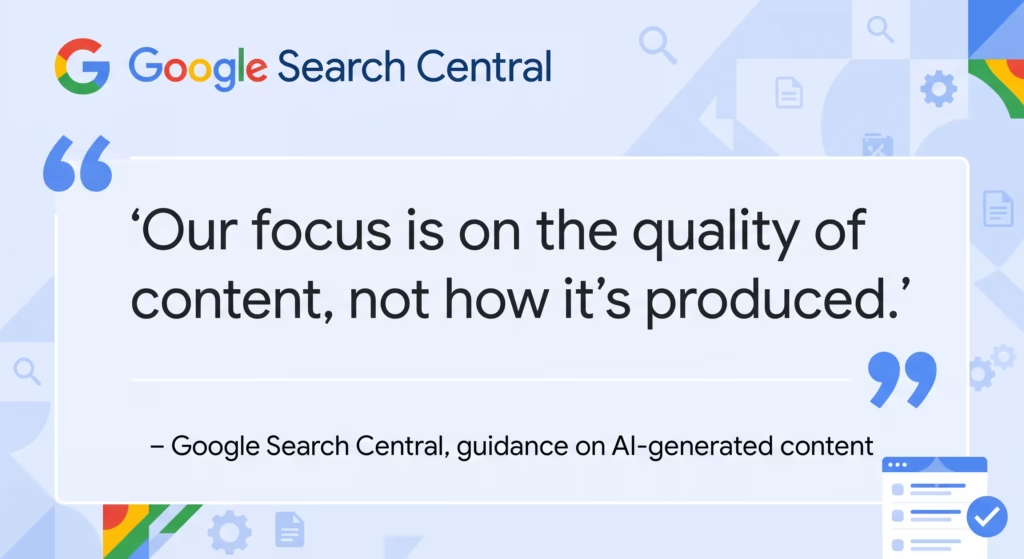
Read that carefully, because it’s the whole rulebook in two sentences. AI to help you research and draft? Fine. AI to flood the internet with pages that add nothing? Not fine. The line isn’t drawn at “AI vs human.” It’s drawn at “helpful vs worthless.”
What Google actually penalises (none of it is “using AI”)
Here’s the part that should calm your nerves — and sharpen your focus. Every real penalty risk is a quality problem, not an AI problem. These are the big ones:
Scaled content abuse. This is the main one. It means generating large volumes of pages primarily to game rankings, with little value for readers. Google named this directly in its March 2024 spam update. And crucially, it applies to human-written filler exactly as much as AI filler — the tool is irrelevant, the behaviour is the target.
Thin, unoriginal content. Pages that just rehash what’s already in the top five results add no “information gain,” as Google calls it. If your page tells the search engine nothing it can’t already find elsewhere, it doesn’t deserve to rank — human or AI.
Fake or missing expertise. Presenting medical, financial, or legal advice with authority you don’t actually have is a serious problem, especially on YMYL (“Your Money, Your Life”) topics. AI can’t fake real experience, and Google’s systems increasingly look for signals that a real, credible person stands behind the page.
The receipts back this up. After the March 2026 core update, sites that had published a thousand or more unedited AI articles saw traffic drops of 40–90%. But sites publishing 50 to 100 well-edited AI articles with human oversight saw traffic increases of 30–80%. Same technology, opposite outcomes. The difference was quality control, not AI usage. An Ahrefs analysis in mid-2026 found the same pattern: lightly-AI pages pulled two to three times the search impressions of heavily-AI ones.
The AdSense angle nobody explains
Rankings are one thing. But you’re a publisher — your income runs through ad networks, and AdSense approval is where a lot of AI-content anxiety really lives. So let’s be clear: AdSense does not prohibit AI-generated content. What it requires is the same thing Google Search wants — original, valuable content with genuine human oversight and real E-E-A-T signals, and no scaled, thin-page abuse.
There’s one extra wrinkle that catches people out, though. AdSense isn’t approving a single article — it’s approving your whole site as an advertising partner. Even if you have a handful of strong posts, your site can be rejected if most of your indexed pages are thin: empty tag pages, stubby archives, placeholder posts, near-identical articles. Site-wide average quality matters more than any single page.
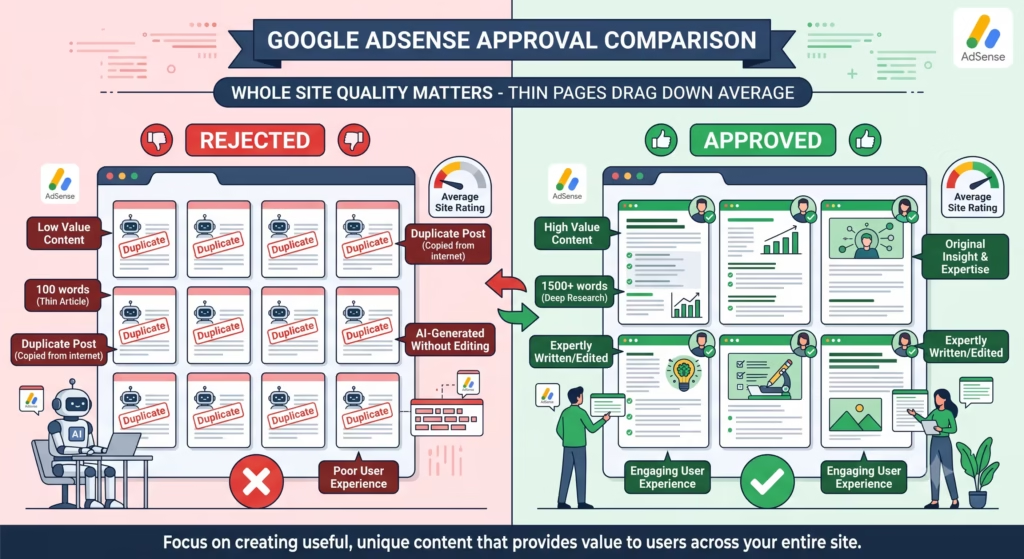
So if you’ve been rejected for “low value content” after using AI, the fix usually isn’t “remove the AI.” It’s: upgrade your best pages with unique examples and real proof, cut or noindex the thin ones, strengthen your author and about pages, then reapply once the improved pages are what Google sees.
Why AI “detectors” don’t factor into this at all
A lot of publishers panic about running their drafts through an AI detector before publishing, terrified of a high score. Here’s the freeing truth: it doesn’t matter, because reliable AI detection doesn’t exist — and Google doesn’t rank based on it.
OpenAI, the company that makes ChatGPT, built an AI text detector and shut it down in 2023 because it was too inaccurate. Independent studies have shown these tools routinely flag human writing as AI, especially work by non-native English speakers, and they’ve even labelled the U.S. Constitution as machine-written. Google almost certainly could run AI detection at scale, but acting on it would contradict its own stated policy and would wrongly punish legitimate publishers who use AI in their workflow. The realistic read is that any AI-detection signal sits far below real quality signals like helpfulness, engagement, and E-E-A-T.
The takeaway: don’t write for a detector. Write for a reader. If you want to check your drafts, use a checker as an editing aid to catch generic, robotic phrasing — not as a pass/fail gate. (Cleaning up that filler makes the writing better anyway, which is the actual point.)
How to publish AI-assisted content safely
So how do the sites that use AI and keep growing actually do it? There’s a consistent pattern, and it’s not complicated. Think of it as a split: let AI handle the part of the work that doesn’t differentiate you, and put your human effort into the part that does.
- Let AI do the drafting scaffolding. Research, outlines, first drafts, restructuring — roughly the 40% of the job that’s the same no matter who does it. This is exactly what Google says AI is useful for.
- Own the 60% that makes it yours. Original insight, first-hand experience, real examples, your opinion, your data. This is the part an answer box or a competitor can’t copy, and it’s what Google’s “information gain” rewards.
- Fact-check everything. AI makes confident mistakes. Every stat, name, and claim gets verified against a primary source before it goes live. On YMYL topics, get genuine expertise involved or skip the topic.
- Put a real name on it. Named authors with real bios, an about page, and clear authorship all send the E-E-A-T signals that help content survive updates and get cited in AI Overviews.
- Add structure machines understand. Clean headings, schema markup (article, FAQ, review), and specific, current facts.
- Choose fewer, stronger pages over more, thinner ones. In 2026, volume is a liability, not an asset. Ten genuinely useful articles beat a hundred rehashed ones — for rankings and for AdSense.
Do this, and AI stops being a risk and becomes what it should be: an efficiency layer that lets a small publisher produce more of the good stuff, faster.
The bottom line
AI content isn’t bad for SEO, and it won’t get your AdSense banned. Bad content is bad for SEO — and AI just makes bad content faster and easier to produce, which is why so many sites got themselves in trouble by leaning on it lazily. The publishers thriving right now aren’t the ones who swore off AI, and they’re not the ones who let it run unchecked. They’re the ones who use it as a tool and keep a human firmly in charge of quality.
So the fear you started with — waking up to lost rankings because a machine helped you write — isn’t the real risk. The real risk is publishing content that doesn’t help anyone, whoever wrote it. Fix that, and you can use every AI tool you like with a clear conscience and a steady revenue line.
(Want to check whether your drafts read as generic or over-polished before you publish? Try our free AI content signal checker — it flags filler phrasing so you can make any piece stronger, human-written or not. And for more on surviving the shift, see our guide to keeping your earnings when AI Overviews cut your clicks.)