Let me guess how your last few months have gone.
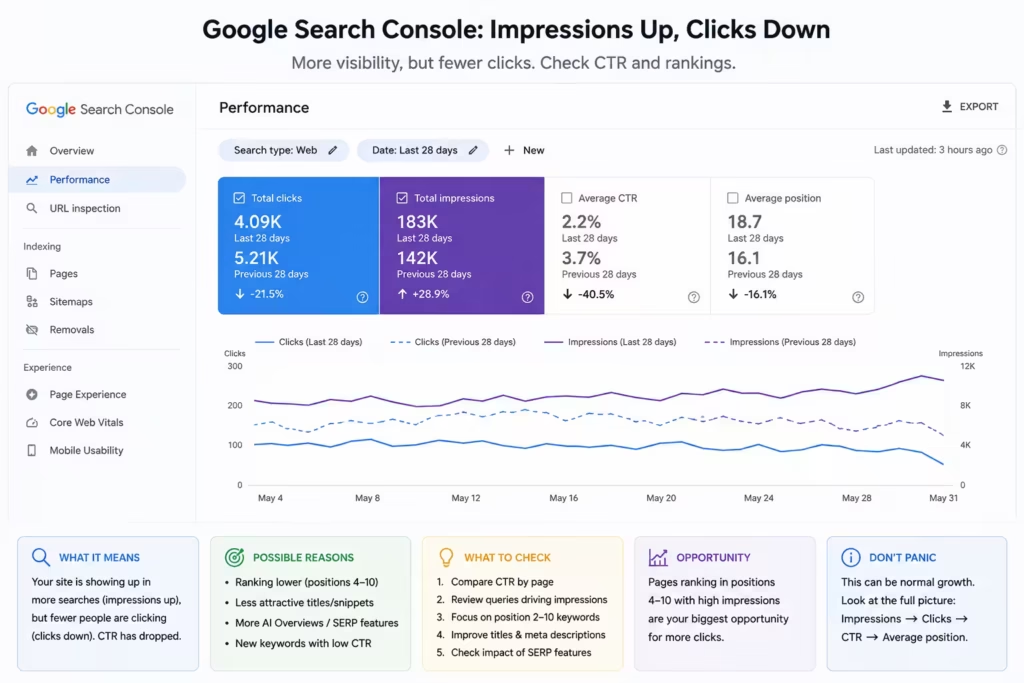
Your rankings didn’t really move. You’re still sitting at the top of page one for the keywords you fought years to win. And yet your traffic is down, your RPM chart looks like a slow leak, and Google Search Console keeps showing impressions climbing while clicks quietly fall off a cliff. You refresh Analytics one more time, hoping it was a bad day. It wasn’t.
If that’s you, take a breath. You’re not being penalised, you didn’t do anything wrong, and your site isn’t broken. What’s happening is bigger than your site — and once you understand it, you can actually do something about it. This is a plain-English guide to what AI Overviews are doing to publisher earnings in 2026, and the practical moves that are still working to keep the money coming in.
First, what’s actually going on
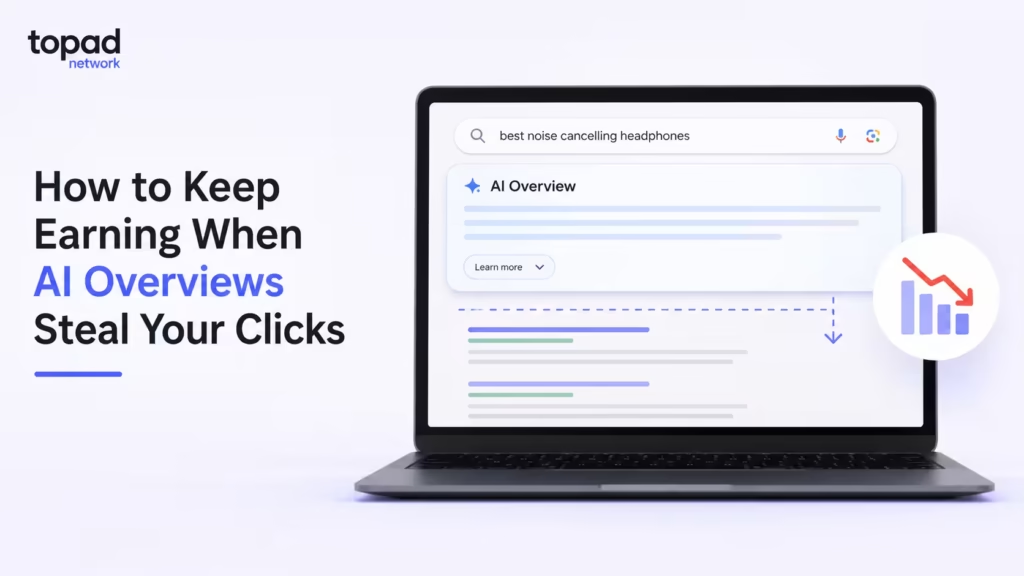
Google’s AI Overviews are those AI-written answer boxes that now sit at the very top of a lot of search results. Instead of a list of blue links, the searcher gets a summarised answer stitched together from pages like yours — and a huge share of them read it, nod, and never click through.
This isn’t a fringe thing anymore. By 2026, AI overviews show up in roughly 60% of U.S. searches, and for a lot of “what is / how to / why does” style queries, the answer is served right there without anyone visiting a website. The cruel part is that your content might be powering that answer while getting none of the visit. You did the work; the box took the credit.
Here’s the mental shift that helps: Google didn’t stop sending you traffic because your content got worse. It stopped sending as much traffic because it started answering the easy questions itself. So the game is no longer “rank number one.” It’s “rank number one for the kind of query that still makes a human click.” Those are two very different things, and the rest of this guide is about the second one.
Step 1: Find out which pages actually got hit
Before you change anything, get honest data. Panic-rewriting your whole site is the worst thing you can do right now.
Open Google Search Console and compare the last three months against the same three months a year ago. Look at the pages where impressions held steady or rose but clicks dropped. That gap is your AI Overviews problem, page by page. You’ll usually see a pattern: the pages bleeding clicks are the informational, top-of-funnel ones — definitions, simple how-tos, “what is X” posts. The pages holding up are the ones with intent behind them: reviews, comparisons, “best of” lists, buying guides, anything where the reader needs to decide something, not just know something.
Write that list down. It tells you exactly where to defend and where to pivot.
Step 2: Lean hard into content AI can’t hand back in a box
An AI Overview is great at summarising facts. It’s genuinely bad at a few things — and those things are your lifeline.
It can’t share a real opinion it stands behind. It can’t tell you what actually happened when it tried the product. It can’t show you a screenshot of its own dashboard, or a spreadsheet of numbers it collected itself, or the mistake it made in month two that cost it $400. That’s the stuff people still click for, because they can smell the difference between a summary and a story.
So shift your energy toward:
- First-hand experience. “I used this for six months, here’s my payout screenshot” beats “here are the features” every time now.
- Strong opinions and takes. Rankings, “worth it or not,” hills you’re willing to die on. AI hedges; you don’t have to.
- Original data. Even a small survey of your audience, or your own test results, gives you something no answer box can generate.
- Comparisons and buying decisions. “X vs Y,” “best tool for beginners,” “is X still worth it in 2026.” These map to real intent and real clicks.
None of this means abandoning helpfulness. It means adding the human fingerprint that a machine can’t fake.
Step 3: Chase the clicks that still convert
Not all traffic is worth the same, and that’s suddenly good news. The queries AI Overviews steal are mostly the low-value ones — the quick facts that never made you much anyway. The queries that still send real visitors tend to be the ones closer to a decision or a purchase.
Point your new content at commercial and transactional intent: product reviews, “best” lists, alternatives posts, pricing breakdowns, hands-on guides. A reader comparing two ad networks before signing up is far more valuable to you than a hundred people who wanted a one-line definition. Fewer visitors, but each one worth more. Build for that reader on purpose.
Step 4: Become the source the AI quotes — and links
Here’s the twist a lot of publishers miss: getting cited inside an AI Overview isn’t nothing. When your site is named as a source, some people do click to verify, dig deeper, or read the full context — and being the quoted authority builds trust that pays off elsewhere.
To improve your odds of being the source it pulls from:
- Answer the core question clearly and early in the article, in a way that’s easy to lift — then expand with the depth the box can’t include.
- Use clean structure: real headings, short direct answers, tidy lists where they fit.
- Add proper schema markup (FAQ, article, review) so machines understand your page.
- Keep your facts current and specific. AI models favour pages that read as accurate and up to date.
Think of it as writing for two readers at once: the human who might click, and the machine deciding whether you’re worth quoting.
Step 5: Stop renting your whole audience from Google
This is the big one, and it’s the difference between publishers who’ll be fine in two years and publishers who won’t.
If Google is your only source of visitors, you don’t really own an audience — you’re renting one, and the landlord just raised the rent. The fix is to build channels you control:
- An email newsletter. This is the single most valuable asset you can build right now. An email list is traffic you own, it lands no matter what Google does, and — bonus — it’s first-party data, which is worth more than ever in 2026 as tracking gets messier across the web.
- A community. A Discord, a Facebook group, a forum, even a simple comments culture. People come back for people.
- Social and video. A YouTube channel or a short-form presence gives you a second front door that doesn’t depend on the search box.
- Direct and returning visitors. The more of your traffic that types your name or bookmarks you, the less an answer box can hurt.
You don’t have to do all of these. Pick one, do it properly, and start turning strangers who found you once into readers who come back on purpose.
Step 6: Earn more from each visitor who does show up
If fewer people are arriving, the math only works if each visit is worth more. This is where your monetisation setup earns its keep.
- Optimise your ads for the whole visit, not the page. Watch EPMV (earnings per thousand visitors), not just page RPM. A platform that tests placements and keeps readers moving through your site will squeeze more from a smaller crowd. This is exactly the case for AI-driven optimisation networks over a plain single-tag setup.
- Add income that doesn’t depend on ad impressions. Affiliate links, a digital product, a paid membership, sponsorships. When ad traffic wobbles, these hold you steady.
- Get your visitors reading more than one page. Tighten your internal linking and your related-posts. If the reader who arrives goes on to read two more articles, you’ve quietly recovered a chunk of what the answer box took.
- Diversify your ad demand. Leaning on one network is risky in a down market. Competition between demand sources is what protects your CPMs when budgets tighten.
Smaller audience, more value per head — that’s the whole survival equation in one line.
Step 7: Play the long game, and don’t burn out chasing every update
It’s tempting to react to every algorithm rumour and every scary headline. Don’t. The publishers who come out of this in good shape are the ones who keep showing up, keep publishing genuinely useful stuff, and keep building assets they own.
Set a rhythm you can sustain. Check your Search Console data monthly, not hourly. Update your best-performing pages so they stay accurate and quotable. Keep feeding your email list. And measure progress over quarters, not days — because that’s the timeframe this shift is actually playing out on.
The bottom line
AI Overviews changed the deal, there’s no sugar-coating that. The easy traffic — the quick facts, the one-line answers — is drying up, and it probably isn’t coming back. But the traffic that’s left is the good kind: readers with intent, decisions to make, and money to spend. And the moves that protect you are the same ones that make a stronger publisher anyway — real experience on the page, an audience you own, more than one way to earn, and a setup that gets the most out of every visit.
You built something that ranks. That’s the hard part, and you already did it. Now you’re just learning to earn from it in a world where the front page looks a little different. Plenty of publishers are doing exactly that right now. So can you.
(Got a strategy that’s working for your site against AI Overviews? Share it in the comments — real numbers and specifics help other publishers more than any theory. And if you found this useful, our guide to the best AdSense alternatives is a good next read.)