If you have ever had a Google AdSense account suspended, or simply watched your AdSense RPM slide month after month, you already know the feeling that pushes publishers to look for something better.
AdSense is easy to start with, but it does very little to actually optimise your earnings — it shows ads, collects a share, and leaves the hard work of placement, testing, and demand competition entirely up to you. This is where Ezoic enters the picture. In this post, I will share an honest and detailed Ezoic Ad Network Review For Publishers — what it is, how the technology works, the ad formats it supports, how it pays, who it is right for, how advertisers can reach its audience, how it compares to the big premium networks, and the one important rule that changed in 2026 that most older reviews still get completely wrong.
By the end of this review, you should know whether Ezoic is the right monetisation partner for your site, or whether you are better off with a simpler network or a fully managed alternative.
What Is Ezoic and How Does It Work?
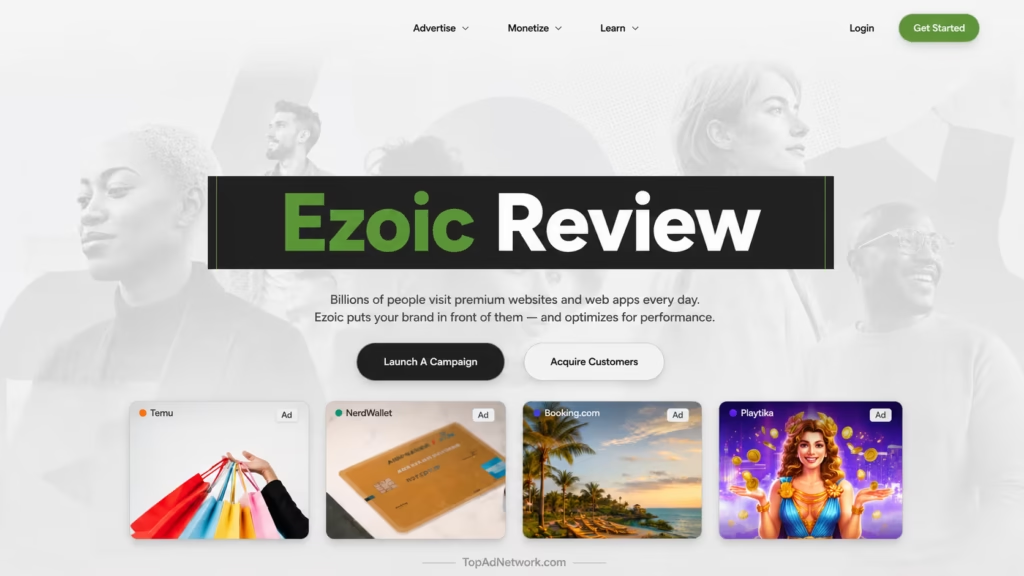
Ezoic is not a traditional ad network like AdSense, Media.net, or Adsterra. It is an AI-driven ad optimisation and mediation platform that has been running since 2010, and it is a Google Certified Publishing Partner — a status Google only grants to a small number of vetted technology companies that meet its policy and quality standards.
The simplest way to understand Ezoic is to think of it as a smart layer that sits between your website and the advertising demand that wants to appear on it. A normal ad network gives you one tag and one source of demand. Ezoic does something different: it connects your inventory to Google Ad Exchange (AdX) and multiple other programmatic demand partners, then puts all of that demand into competition for every single impression on your site. On top of that competition, it runs machine-learning tests on where your ads sit, how many appear, and what sizes are used, so that the layout that actually earns the most is the one your visitors see.
This is a meaningful shift in how monetisation works. With AdSense, you are essentially guessing — you place ad units where you think they belong and hope they perform. With Ezoic, the platform gathers data from your real visitors and lets the AI decide, continuously, which arrangement produces the highest earnings without destroying the reading experience. That testing never really stops; it keeps adapting as your traffic, content, and seasonality change.
Because of this design, Ezoic is best understood as a publisher-side revenue technology, not a demand-side buying tool. That distinction matters a lot for advertisers, and we will come back to it in detail later in this review.
Understanding EPMV — The Metric That Sets Ezoic Apart
Before we go further, you need to understand one term, because it runs through the entire Ezoic experience: EPMV, which stands for Earnings Per Thousand Visitors.
Most ad networks report RPM (Revenue Per Thousand Impressions or per thousand pageviews). RPM is a page-level metric — it tells you what a batch of pageviews earned. The problem is that RPM can tempt publishers into stuffing more ads onto a page, because more ads often means a higher page RPM in the short term, even if those extra ads drive readers away.
EPMV looks at the entire visit instead of a single page. It measures what an average group of one thousand visitors earns across their whole session — every page they read, every ad they see, and crucially, how long they stay before they leave. This changes the incentive completely. Under EPMV, an aggressive layout that earns more per page but chases visitors off after one pageview will show a lower EPMV, because those visitors never went on to read a second or third page. A cleaner, faster layout that keeps people reading will often show a higher EPMV even if each individual page earns a little less.
Ezoic’s whole optimisation engine is tuned to maximise EPMV, which is why the platform cares so much about site speed and user experience. When you read your Ezoic dashboard, EPMV is the number you should watch, not page RPM. It is a more honest picture of whether your monetisation is actually healthy.
Ezoic Ad Network Features
Ezoic is built around one idea: let the AI and the tooling do the heavy lifting that a publisher would otherwise have to do by hand. Over the years, it has grown from a simple ad tester into a full suite of products. Here are the core features you get to work with once you join.
- AI Ad Placement (Ad Tester).
- EPMV Reporting & Big Data Analytics.
- Site Speed Tools (LEAP).
- Content & Video Tools (NicheIQ, Flickify, Humix).
- Ezoic Premium.
1. AI Ad Placement (Ad Tester): This is the heart of the platform. Ezoic automatically tests different ad locations, sizes, and densities against your real visitor behaviour, then serves the combination that earns the most while protecting the reading experience. You define “placeholders” — areas of your layout where ads are allowed — and the AI experiments within those boundaries. You are not guessing where ads should go; the system works it out from data and keeps refining it.
2. EPMV Reporting & Big Data Analytics: Ezoic’s analytics go far beyond what AdSense shows you. The Big Data Analytics dashboard breaks down your highest-earning pages, your best keywords, engagement time, bounce behaviour, and how different visitor segments perform. For a content publisher, this is genuinely useful, because it tells you which articles actually make money — so you can plan future content around what your audience values instead of guessing.
3. Site Speed Tools (LEAP): Ad scripts are heavy, and heavy scripts slow a site down, which hurts both user experience and SEO. To counter that, Ezoic bundles LEAP, a set of tools aimed at improving page load times and Core Web Vitals — lazy loading, caching, image optimisation, script deferral, and more. Faster pages mean lower bounce rates, longer sessions, and often better search rankings, all of which feed back into a higher EPMV.
4. Content & Video Tools (NicheIQ, Flickify, Humix): Ezoic has expanded well beyond ads. NicheIQ offers SEO and content suggestions, helping you find topics and keywords worth targeting. Flickify can turn a written article into a video automatically. Humix is Ezoic’s video-sharing network, where publishers can host video and even share views across other Humix sites to earn additional revenue. These tools are optional, but they add ways to monetise and grow that a plain ad network simply does not offer.
5. Ezoic Premium: This is an optional paid tier that unlocks access to higher-value, direct, and premium advertiser demand. For sites with strong engagement, Premium can add a meaningful revenue bump. But it is a pay-to-play add-on — you pay a monthly subscription for it — and it is not something every publisher needs on day one. More on this in its own section below.
Alongside these products, a few structural points matter for publishers before you sign up.
- Not a fully managed network – Ezoic gives you powerful tools, but you stay hands-on. There is a learning period while the AI gathers data, and your results can vary by niche, geography, and traffic quality. This is not a “set it and forget it” partner in the way some managed networks are.
- JavaScript integration – The recommended way to connect is via a small JavaScript snippet. This is far safer than the old DNS/nameserver integration that Ezoic used years ago, which occasionally broke sites. If you read an old review that warns about DNS problems, know that the modern JS method has largely solved that.
- No lock-in on the standard platform – You can remove Ezoic at any time on the free platform. The one exception is Ezoic Premium, which can carry a commitment and a termination fee, so read those terms carefully before opting in.
- Non-US and non-English sites welcome – Ezoic does not reject a site just because most of its traffic sits outside the United States or is in another language, which makes it usable for a much wider range of publishers than some premium networks.
Ezoic Ad Formats
Ezoic supports the full range of standard display and rich media formats, and its AI decides which ones to use where. The common formats include:
- Display banners in standard IAB sizes (leaderboard, medium rectangle, large skyscraper, and more).
- In-content ads placed intelligently between paragraphs of your articles.
- Sidebar ads, including sticky sidebar units that stay visible as the reader scrolls.
- Anchor / sticky ads that dock to the top or bottom of the screen.
- Native ads that blend with your site’s look and feel.
- Video ads, including units powered through Humix and video placements that carry higher CPMs.
Because placement is automated, you are not manually choosing every unit. You mark where ads are permitted, set your comfort level for ad density, and let the system test combinations. Publishers who want more control can tighten those settings; publishers who want maximum revenue can give the AI more room to work.
Requirements For The Publisher To Join Ezoic
This is the part that changed, and it is the single most important thing in this review — because almost every older Ezoic review on the internet is now out of date on it.
For years, Ezoic proudly had no minimum traffic requirement, which made it the default recommendation for small and growing blogs. That is no longer true for new publishers.
- 250,000 monthly users for new sites. Any new site added after 19 February 2026 must meet a 250,000 monthly users requirement to join the main platform. This is a major jump and it rules out most small blogs from joining directly.
- Grandfathered status. Sites that were already monetising with Ezoic before that date are grandfathered in regardless of their current size, as long as they keep using the platform continuously and do not fall foul of the rule below.
- The 7-day rule. If a grandfathered site removes its Ezoic integration for more than 7 days, that grandfathered status is void. To come back, the site must then meet the full 250,000-user requirement like any new site. In plain terms: if you are grandfathered in, do not rip Ezoic out on a whim, because you may not get back in on the old terms.
- Ezoic Incubator. Smaller, growing sites that do not yet hit 250k monthly users may be eligible for the Ezoic Incubator Program, which is designed to help them scale toward full platform eligibility. This is the realistic on-ramp for newer publishers now.
- Google policy compliance. As a Google Certified Publishing Partner, Ezoic requires your site to comply with Google/AdSense policies — original, high-quality content only, and no adult, illegal, gambling, or otherwise prohibited content.
- Technical requirement. Beyond the above, the only universal technical requirement is that your site can run JavaScript.
So the honest summary for 2026 is this: if you are an established publisher above 250k monthly users, or you are already grandfathered in, Ezoic is open to you. If you are a smaller site, your path is the Incubator, or you look at a lower-threshold alternative and graduate to Ezoic later.
How To Get Started With Ezoic (Publishers)
Getting started is straightforward, even if the platform itself has a learning curve afterward. Here is the typical flow:
- Apply. Head to the Ezoic website and click Get Started to begin the application.
- Connect Google Analytics. Ezoic asks you to connect your Google Analytics so it can verify your traffic level against the current requirements.
- Add your site and integrate. Add your website and connect using the recommended JavaScript integration method. This is quick and does not require handing over your nameservers.
- Set up placeholders. Define the areas of your layout where ads are allowed to appear. This is where you control the balance between revenue and reader experience.
- Let the AI learn. Once you are live, the system begins testing placements, sizes, and densities, and starts optimising for EPMV.
The most important piece of advice here is patience. Do not judge Ezoic on a single day’s numbers. The AI needs a few weeks of data to settle into an optimised configuration, and early results — especially in the first days after integration — are not representative of what the platform will eventually deliver. Compare your before-and-after EPMV over several weeks, not overnight.
Payment Details (Publishers)
Ezoic pays publishers monthly on a Net-30 basis. In practice, this means the earnings for a given month are typically paid out at the end of the following month. So January’s earnings are usually paid at the end of February, and so on.
The minimum payout is just $20, which is low and friendly to newer earners — you are not waiting forever to hit a $100 threshold like some networks demand. Ezoic also has a solid reputation for paying on time, which is one of the most important things you can say about any ad network. Payments are automatic once you clear the threshold; you do not have to request them manually.
For withdrawals, you can choose from standard options such as PayPal, Payoneer, and wire transfer / direct deposit, which covers the vast majority of publishers worldwide. (Always confirm the current list of payment methods and any regional details inside your own dashboard, as these can change.)
Ezoic Premium — Is The Paid Tier Worth It?
Ezoic Premium deserves its own section because it is the part of the platform that generates the most debate.
Premium is an optional, paid subscription that gives your site access to higher-value, direct, and premium advertiser demand that is not available on the free platform. The pricing is not flat — it is based on your traffic level, and it generally starts at a subscription of over $100 per month, scaling up for larger sites. Some Premium plans are offered on a commitment basis, and leaving early can involve a termination fee, so you should read the terms before you commit.
The honest verdict from the publisher community is mixed. When Premium works, the extra premium demand can more than pay for the subscription, effectively giving you a net revenue lift. When it does not — for example on sites with lower engagement, or in seasons where premium demand is soft — you can end up paying a monthly fee that eats into or wipes out the additional revenue. The “pay-to-play” nature of it rubs some publishers the wrong way, because you are being asked to spend money to unlock the better ads.
My advice: do not rush into Premium. Run the standard platform first, establish a baseline EPMV, and only add Premium once you can measure whether it genuinely nets out positive for your specific site. Treat it as an experiment with clear before-and-after numbers, not a default.
Ezoic For Advertisers
Here is where Ezoic differs from most networks you will find listed on this site, and where a lot of confusion happens. Ezoic is publisher-first, and it does not run a traditional self-serve advertiser dashboard the way Adsterra, PropellerAds, Adcash, or Kadam do. You cannot simply sign up as an advertiser, deposit a balance, upload creatives, and launch a pop, push, or display campaign directly inside Ezoic.
Instead, advertisers reach Ezoic’s publisher inventory the same way they reach any premium programmatic inventory:
- Through Google Ad Exchange and Google Ads. Because Ezoic connects publisher inventory to Google Ad Exchange, advertisers bidding through Google Ads and DV360 can automatically compete for those impressions. If you run Google Ads campaigns, you may already be buying Ezoic-monetised inventory without knowing it.
- Through header bidding and DSPs. Ezoic runs many demand partners and exchanges in competition for each impression, so demand-side platforms (DSPs) can bid on the inventory programmatically as part of the open marketplace.
- Targeting is programmatic, not manual. Advertisers do not hand-pick individual Ezoic sites from a menu. You target the audience — by geography, device, interests, contextual category, and so on — through your buying platform, and the real-time auction decides where your ad actually lands.
What this means in practice: if you are an advertiser, Ezoic is not a network you “join.” It is a source of high-quality, speed-optimised publisher inventory that you buy against through the programmatic pipes you already use. Because Ezoic sites tend to be genuine content sites that comply with Google policies and load fast, the inventory is generally brand-safe and attractive for advertisers who care about context and viewability.
For brands that want direct, curated placements on specific high-performing content sites, the closest thing in the Ezoic ecosystem is the premium and direct demand that flows through the Premium program on the publisher side. That is also the reason strong Ezoic sites tend to attract better-paying, brand-safe advertisers rather than the low-quality ads you sometimes see on aggressive pop or redirect networks.
Ezoic Advertising Network Details
| Ezoic | Ad Network Details |
|---|---|
| Ad Network Type: | AI Ad Optimisation / Display (programmatic CPM) |
| Best For: | Publishers (monetisation); advertisers buy inventory programmatically |
| Available Ad Formats: | Display banners, native, in-content, sidebar, video, and anchor/sticky units |
| Minimum Payment: | $20 (publisher payout) |
| Payment Frequency: | Monthly, Net-30 |
| Payment Method: | PayPal, Payoneer, Wire Transfer / Direct Deposit |
| Accepted Websites: | No adult, gambling, or illegal content; new sites need 250k+ monthly users |
| Advertiser Access: | Via Google Ad Exchange, Google Ads/DV360, header bidding & DSPs (no self-serve) |
| Referral Program: | Yes – revenue share on referred publishers (check current terms) |
| Country: | USA (Carlsbad, California) with a UK office |
| Official Website: | https://www.ezoic.com/ |
| Join This Ad Network: | Join Ezoic |
Pros and Cons of Ezoic
No network is perfect, and a fair review has to weigh both sides. Here is the honest balance sheet.
Pros:
- Often beats AdSense earnings. With demand competition and AI placement, many publishers report a higher EPMV than they achieved with AdSense alone.
- Excellent analytics. The Big Data Analytics dashboard is genuinely useful for understanding which content and keywords make money.
- Free site-speed tools (LEAP). Improving Core Web Vitals is valuable on its own, and you get it bundled in.
- Low $20 payout and reliable, on-time payments. Friendly to newer publishers, and dependable once you are earning.
- No contract on the standard platform. You can leave the free platform whenever you like (mind the 7-day grandfathering rule if you are on legacy terms).
- Extra monetisation and growth tools. Humix video, Flickify, and NicheIQ add options a plain ad network does not offer.
- Accepts non-US and non-English sites. Broadens who can actually benefit.
Cons:
- The 250k requirement for new sites (from Feb 2026). Small publishers can no longer join directly and must use the Incubator.
- Learning curve and complexity. The dashboard and settings can overwhelm non-technical publishers.
- Not fully managed. You stay hands-on; results depend on your effort and your traffic quality.
- Support can be slow. A recurring complaint is that replies take time and are not always helpful.
- Premium is pay-to-play. The best demand sits behind a paid subscription that does not net out positive for every site.
- Integration incompatibilities. It can clash with setups like Cloudflare full-page cache and certain hosts or plugins.
- Revenue varies. Niche, geography, and seasonality all affect results, so outcomes are not guaranteed.
How Ezoic Compares To Other Networks
Publishers weighing Ezoic almost always compare it against a handful of alternatives. Here is where it sits.
- Ezoic vs AdSense: AdSense is simpler and has no traffic floor, but it does not optimise for you and generally leaves money on the table. Ezoic adds demand competition and AI testing on top of (or in place of) AdSense, usually producing a higher EPMV — at the cost of more complexity and, now, a traffic requirement.
- Ezoic vs Mediavine: Mediavine is a premium, fully managed network with high revenue but a demanding traffic threshold and a more hands-off experience for the publisher. Ezoic gives you more control and tooling but expects you to do more of the work yourself.
- Ezoic vs Raptive (formerly AdThrive): Raptive targets larger, established publishers with premium managed service and strong RPMs, but with a high entry bar. Ezoic is more accessible for the mid-tier and more DIY.
- Ezoic vs Monumetric: Monumetric sits in the mid-market with a setup fee for smaller sites and a managed feel. Ezoic has no setup fee on the standard platform and leans on automation instead of hands-on management.
- Ezoic vs managed alternatives (e.g. Newor Media, AdPushup): These often offer lower entry thresholds and fully managed optimisation, which appeals to publishers who do not want to babysit a dashboard. Ezoic trades that hand-holding for deeper tools and analytics.
The short version: Ezoic is best for the established, reasonably technical publisher who wants control, data, and automation in one place, and who clears the traffic bar or is grandfathered in.
Frequently Asked Questions
Is Ezoic better than AdSense? For most established sites, yes — because Ezoic puts multiple demand sources in competition and optimises placement automatically, it typically earns more per visitor than AdSense alone. But it is more complex, and since February 2026 it has a 250k-user requirement for new sites that AdSense does not.
Does Ezoic have a minimum traffic requirement? Yes, now it does for new sites: 250,000 monthly users for any site added after 19 February 2026. Sites already on Ezoic before then are grandfathered in, and smaller sites can apply to the Ezoic Incubator.
How much does Ezoic pay? It varies by niche, geography, and traffic quality, and the metric to watch is EPMV. Ezoic pays monthly on Net-30 with a low $20 minimum payout, and it has a strong track record of paying on time.
Can I use Ezoic and AdSense together? Yes. Many publishers keep AdSense as one of the demand sources that competes inside Ezoic, rather than choosing one or the other.
Is Ezoic free? The standard platform is free — Ezoic makes money by taking a share of ad revenue. Ezoic Premium is a separate paid subscription for access to premium demand.
Can advertisers buy directly on Ezoic? No. Ezoic is publisher-first with no self-serve advertiser panel. Advertisers reach Ezoic inventory programmatically through Google Ad Exchange, Google Ads/DV360, header bidding, and DSPs.
The Conclusion
For publishers, Ezoic is one of the strongest AdSense alternatives available if you have real, established traffic and you are willing to be a little hands-on. When it works, it works well: publishers regularly report EPMV that beats AdSense alone, the analytics are genuinely useful for planning content, and the free LEAP speed tools are a real bonus. It pays on time, the minimum payout is low, and there is no contract on the standard platform. The trade-offs are equally real — a learning curve, a dashboard that can feel complex, support that is not always fast, occasional incompatibility with setups like Cloudflare’s full-page cache, and the pay-to-play Premium upsell. And the big one for 2026: new sites now need 250,000 monthly users, so smaller publishers will need the Incubator route rather than joining directly.
For advertisers, the takeaway is different: Ezoic is not a buying platform you sign up for; it is high-quality publisher inventory you reach programmatically through Google Ad Exchange, Google Ads, and DSPs. If your goal is brand-safe, speed-optimised placements on genuine content sites, Ezoic-monetised inventory is well worth targeting through your existing programmatic buys — you simply will not manage it inside an Ezoic advertiser panel, because there is not one.
My final take: if you are a publisher who is grandfathered in or clears the traffic bar, Ezoic is well worth testing against your current setup — measure your EPMV over a few weeks before you decide, and treat Premium as a separate experiment with its own before-and-after numbers. If you are a small site, look at the Incubator or a lower-threshold managed alternative first, then graduate to Ezoic as you grow. Used with realistic expectations, it remains one of the most capable monetisation platforms a serious publisher can put on their site.
(P.S. – If you are the owner or a representative of this ad network and find any detail here is outdated or needs changing, kindly reach us through the Contact Us page. For the most accurate and current details, please check the official website’s Terms & Conditions.)
Similar Ad Network