For twenty years, digital advertising followed one path: a user searched, a webpage loaded, an ad slot opened, and an auction filled it. That model is now being rebuilt in real time. As people increasingly ask AI assistants what to buy, compare, and choose — instead of clicking through a page of blue links — a new category of infrastructure has appeared to monetize those conversations. We call them AI advertising networks, and 2026 is the year they moved from pitch deck to production.
This guide explains what these networks are, how they differ from the ad tech you already know, and which platforms are worth watching now. Just as importantly, it draws a line most listicles ignore: not every company here is an “ad network.” Some are networks, some are exchanges, some are publisher-monetization and attribution systems, and a couple are walled-garden platforms selling only their own inventory. Knowing the difference is the difference between choosing the right partner and wasting a quarter.

What Is an AI Advertising Network?
An AI advertising network is a system that connects advertisers with inventory inside AI-generated experiences — chat assistants, AI search engines, copilots, coding agents, companion apps, and voice interfaces — rather than inside web pages or mobile feeds.
The distinction is not cosmetic. Traditional networks are built around a pageview or a feed impression: a fixed slot on a fixed surface, targeted using cookies and behavioral profiles. An AI advertising network is built around a moment of expressed intent. When a user types “what’s a good standing desk under $400,” they have just told the system, in their own words, exactly what they want. The monetizable unit is the answer or recommendation itself, not a banner bolted onto the side of it.
Because of that, AI-native networks tend to share a few traits: contextual matching based on live conversation rather than third-party tracking, native ad formats that read as recommendations instead of interruptions, clear “sponsored” labeling to protect trust, and outcome-based pricing tied to clicks or actions rather than raw impressions. As one AI-native network puts it, the category should not be reduced to “ads in chat” — the real innovation is the logic layer that decides when sponsorship appears, how relevance is judged, and how the result is measured.
How AI Advertising Networks Work
The mechanics vary by vendor, but most AI advertising networks route through the same basic pipeline:
Advertiser → AI ad network → AI application → user
- The advertiser defines intent, not just creative. Instead of uploading a banner and a keyword list, advertisers describe their product, ideal customer, messaging rules, and the situations in which they want to appear. Several networks package this as a persistent “brand agent” that learns when to participate.
- The AI application sends conversation context. A publisher — say, a consumer chatbot or an AI search tool — passes the network signals about the current exchange: topic, intent category, and stage of the decision. This usually happens through a lightweight SDK or API call, not a redesign of the product.
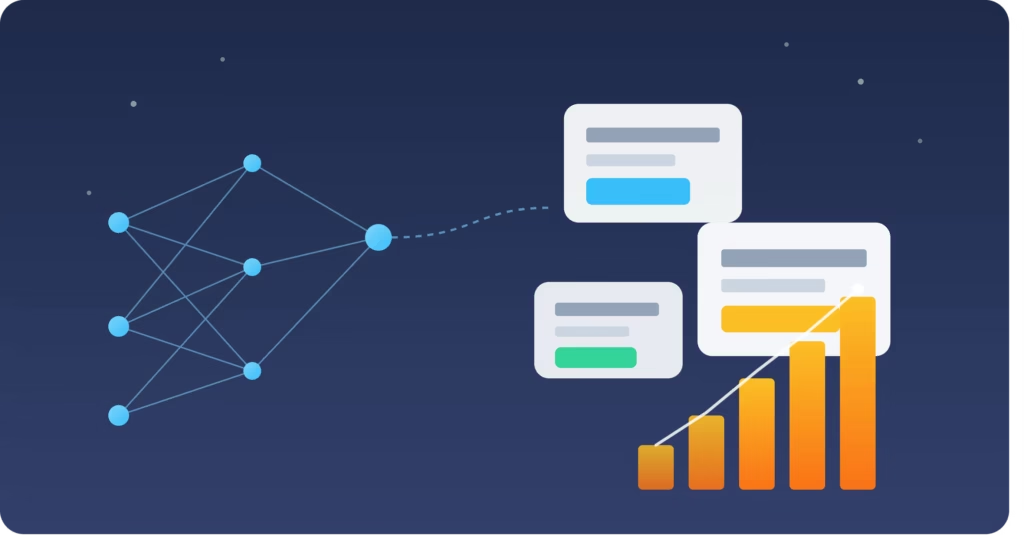
- The network matches and ranks in milliseconds. It analyzes the prompt (and often the whole multi-turn conversation), decides whether commercial intent is high enough to justify a placement, runs an auction among eligible advertisers, and returns the winner in a structured format the app can render natively.
- The ad appears inside the answer — clearly labeled. Depending on the format, that might be a sponsored recommendation woven into the response, a product card beneath it, a follow-up question, or a sidebar unit.
- Billing is tied to outcomes. Most networks charge on clicks, engagements, or verified actions rather than impressions alone, aligning cost with performance.
The result is an advertising layer designed for a “zero-click” world, where the answer is the destination and the ad has to earn its place inside a helpful response.
Best AI Advertising Networks in 2026
Below are the platforms shaping this category. We’ve grouped them honestly by what they actually are, because “AI ad network” has become a marketing label that gets applied loosely.
AdMesh — Agentic ad network for AI conversations
Type: Ad network / marketplace
AdMesh launched its agentic advertising network at the start of 2026, positioning itself as infrastructure purpose-built for AI-native interfaces. Its signature idea is the Brand Agent: advertisers upload their brand story, product details, ideal customer profile, targeting rules, and bidding preferences, and the agent autonomously decides when to enter an auction and how to represent the brand inside a relevant conversation. Monetization occurs only when intent is detected — not during passive browsing — and the architecture avoids third-party cookies and cross-site tracking.
For publishers, AdMesh ships an SDK (a simple npm install) that returns recommendations in one of a few predictable formats — Tail Ad, Product Card, or Weave — so AI products can display sponsored options without redesigning their UX. The company spans all three sides of the market: advertiser demand, publisher monetization, and AI-platform monetization, and has since added a workflow that helps brands manage ChatGPT Ads campaigns from the same dashboard. Founded by Mani Kumar Gouni (CEO) and Jason Rydzewski (COO), AdMesh is one of the clearest examples of the “agentic” model in production.
Best for: AI apps and advertisers that want a configurable, agent-based sponsor layer rather than generic placement buying.
Thrad — The DSP (and SSP) for LLMs
Type: Full-stack infrastructure (demand-side + supply-side)
Thrad describes itself as “paid ads in AI” and provides end-to-end infrastructure for running advertising inside conversational AI. Uniquely, it operates both sides: a DSP for advertisers who want to buy across a growing inventory of AI apps (including ChatGPT), and an SSP for publishers who want to monetize their LLM or chatbot. Its engine performs real-time prompt analysis, ad ranking, and contextual deployment, and it can adapt approved creatives or product feeds into native, app-appropriate units on the fly — so brands don’t have to build bespoke creative for every surface.
Thrad has moved quickly on distribution, announcing a global partnership with DeepAI — one of the most-visited consumer AI destinations — in February 2026, and it publishes playbooks for advertising across ChatGPT, Gemini, Perplexity, and Claude. Its team notably includes advertising leadership drawn from Perplexity AI, and its stated mission is to keep AI free through advertising.
Best for: Advertisers and publishers who want a single integration that spans buying and selling across many AI surfaces.
ProRata (Gist) — Publisher AI search, attribution, and monetization
Type: Broader than an ad network — AI-search + attribution + Gist Ads
ProRata, founded by Idealab’s Bill Gross in 2024, is often lumped in with AI ad networks, but it’s really a wider system built around an ethical, licensed-content model. Its consumer AI search engine, Gist.ai, answers questions using only content licensed from publisher partners, and its Gist Answers product lets those publishers embed AI search, summarization, and recommendations directly on their own sites. The advertising piece — Gist Ads — transforms AI answers into native ad inventory, placing conversational ads adjacent to responses.
What sets ProRata apart is attribution and revenue sharing: it pays partners 50% of revenue on a recurring basis, proportional to how often their content powers a given answer. The company has signed 500–700+ publications, including major names, and raised a $40 million Series B (led by Touring Capital) in September 2025, bringing total funding above $75 million. If your priority is publisher-side monetization tied to content licensing and fair attribution — rather than buying ads across third-party AI apps — ProRata is a different animal from the pure networks above.
Best for: Publishers who want to monetize their own AI experiences and be compensated when their content fuels AI answers.
Surfacedd — Cross-platform network of conversational ad units
Type: Ad network
Surfacedd runs a network that places clearly disclosed “Surfaces” inside AI outputs, and it leans hard into being cross-platform rather than tied to any single AI app. Its main asset is a library of conversational ad-unit components — SponsoredAnswer, SponsoredCard, SponsoredFollowup, SponsoredSidebar, and SponsoredVoice — that publishers drop into their product via SDK, with disclosure and rendering handled for them. It explicitly frames itself against single-platform lock-in (such as buying only ChatGPT Ads) and against retrofitted display formats, arguing that labeled sponsored answers and post-response units earn far higher engagement than banners jammed into a chat window.
Note a naming trap: several similarly named products (Surfacd, Surfaced) are AI-visibility or answer-engine-optimization tools, not ad networks. Surfacedd (double “d”) is the advertising network.
Best for: AI apps that want a menu of native, disclosure-ready ad formats across multiple surfaces.
Kontezza — Native ad platform for AI agents
Type: Ad network
Kontezza is a native-advertising platform aimed squarely at AI agents and conversational apps. It analyzes dialog semantics in real time and surfaces relevant recommendations inside the conversation. Its pitch to publishers is straightforward developer economics: SDK integration in about five minutes, earnings starting from roughly a $3 eCPM, and revenue share up to 80%. On the advertiser side, it promises high-intent traffic captured “exactly when [users are] forming their request.” It currently works with a limited set of partners, consistent with an early-stage network building supply carefully.
Best for: AI developers who want fast, high-revenue-share monetization with minimal integration overhead.
Oyoo.ai — Prompt-based ads for AI agents
Type: Ad network
Oyoo.ai positions itself as an ad network for AI agents and conversational apps, built around prompt-based ads, a semantic ad-serving SDK, and privacy-first ad injection. Its emphasis on semantic targeting and privacy-safe insertion places it in the same lane as Kontezza and Surfacedd: a supply-and-demand network that helps AI publishers monetize prompts without behavioral tracking.
Best for: Conversational AI publishers prioritizing semantic, privacy-first monetization.
Honorable mentions and the walled gardens
The category is crowded and moving fast. Kontext raised a $10M seed to build LLM-tailored ad formats for consumer AI apps (with CPMs starting around $3), and other players — Koah Labs, ChatAds (an affiliate, bring-your-own-account model), ZeroClick, Adgentic, Imprezia, and Monetzly among them — are each carving out niches.
Separately, the walled gardens are not open networks but matter enormously. OpenAI’s ChatGPT Ads and Google’s AI Mode ads sell only their own inventory, but between them they define pricing, formats, and user expectations for everyone else (more on both below).
AI Advertising Networks vs Traditional Ad Networks
The contrast is best understood across a few dimensions:
- Surface: Traditional networks fill slots on web pages and app feeds. AI networks fill space inside generated answers and recommendations.
- Signal: Traditional targeting leans on cookies, device IDs, and behavioral history. AI networks read live conversational intent — often the user’s exact words — and typically avoid third-party tracking.
- Format: Banners and pre-rolls versus native sponsored answers, product cards, and follow-up prompts designed to look like part of the response.
- Timing: Traditional ads interrupt browsing; AI ads aim to appear at the decision moment, when a user is actively comparing options.
- Measurement: Impressions and viewability versus intent-aligned clicks, engagements, and verified actions.
One practical wrinkle: major legacy networks such as AppLovin and The Trade Desk have historically been wary of AI-generated content, citing brand safety and the lack of standardized formats. That reluctance is part of why AI-native networks exist at all — the incumbents left a gap, and specialists filled it.
AI Advertising for Publishers
If you run an AI product — a chatbot, an AI search tool, a companion app, a vertical copilot — advertising is quickly becoming a serious answer to a hard problem: inference is expensive, and free users can be a losing proposition on subscriptions alone.
AI advertising networks give publishers a way to add revenue without a paywall and, ideally, without degrading the experience. Integration is usually a lightweight SDK or API call. Revenue shares are attractive relative to legacy display — some networks advertise up to 80% to the publisher — and because the ads are native and intent-matched, complaint rates tend to run lower than the interruptive display ads early experiments relied on. The strategic caution is simple: the moment sponsored content feels like it’s bending the assistant’s real answer, you’ve traded long-term trust for short-term yield. Choose formats and disclosure that keep that line bright.
AI Advertising for Advertisers
For advertisers, the appeal is intent quality. A user asking an AI assistant for a recommendation is deep in a decision — often further along than someone idly scrolling a feed. Early data backs the intuition: Adobe figures reported in 2026 found that AI-referred traffic to US retailers converted markedly better than other traffic and drove higher revenue per visit, even though the raw volume is still small.
That changes how to read the metrics. Click-through rates inside chat look low next to search — industry chatbot CTR benchmarks sit near 1% against roughly 6% for Google search ads — but the traffic arrives “pre-sold,” after a recommendation rather than before a comparison. A 1% CTR feeding high-converting, high-intent traffic can out-earn a 6% CTR feeding cold clicks. The honest advertiser takeaway for 2026: treat AI advertising as a test-and-learn channel with real intent value, not as a like-for-like swap for paid search.
How Much Does AI Advertising Cost?
Pricing in this category is young and inconsistent, so treat every number as a moving target. Broadly, three models are in play:
- Independent AI networks tend to price like performance channels. Publisher-side eCPMs often start around $3 (Kontezza and Kontext both cite figures in that range), with advertiser billing on clicks, engagements, or actions. Kontext, for example, reports 3–5% CTRs across categories and claims materially better CPA/CPI than legacy channels.
- OpenAI’s ChatGPT Ads operate at premium, walled-garden rates. Reports put the pilot CPM near $60 with a $200,000 minimum commitment for early advertisers — priced like exclusive professional inventory, not bargain traffic. ChatGPT ads reportedly reached roughly $100M in annualized revenue within about six months of the US test beginning.
- Google AI Mode folds into existing auctions via Performance Max and AI Max for Search. Early data shows ads appearing in roughly a quarter of AI Mode results at about 35% higher CPCs than traditional search, alongside higher engagement. For context, average Google Search CPC sat near $2.96 in early 2026.
The pattern: independent networks compete on efficiency and revenue share; the big platforms command a premium for scale and audience quality. Where your budget belongs depends on whether you’re optimizing for reach, cost, or control.
Advantages of AI Advertising
- Intent at the decision moment. You reach users precisely when they’re choosing, not hours before.
- Native, less intrusive formats that blend into the experience and tend to protect trust and engagement.
- Privacy-forward targeting. Contextual, conversation-based matching reduces reliance on cookies and behavioral profiles.
- New inventory and new revenue. Advertisers get an under-monetized, high-intent audience; publishers can fund expensive AI products without paywalls.
- Higher-quality traffic, with early evidence that AI-referred users convert better than the norm.
Risks and Challenges
- Trust is fragile. If ads appear to influence the assistant’s genuine answer, users notice fast — and skepticism about AI advertising is already loud.
- Immature measurement. Aggregated reporting, low published-benchmark availability, and AI traffic landing in analytics as “direct” make performance hard to read.
- Fragmentation. Dozens of networks, inconsistent formats, and no shared standards mean integrations and comparisons are messy.
- Volatile pricing and rules. Platforms are changing eligibility, pricing, and policy on a near-monthly basis.
- Brand safety and disclosure. Ensuring ads land in appropriate contexts — and are clearly labeled — is non-negotiable and still evolving.
- Regulatory uncertainty. Data use and targeting inside AI conversations will draw scrutiny, likely sooner rather than later.
How to Choose an AI Advertising Network
A few questions cut through the noise:
- What is it, really? A network, an exchange, a DSP/SSP, or a publisher-monetization system? Match the tool to your role.
- Which side are you on? Advertisers want reach and intent quality; publishers want revenue share, easy integration, and UX control. Some platforms (like Thrad) serve both; others specialize.
- How native and how disclosed are the formats? Look for clearly labeled, conversation-appropriate units — not retrofitted banners.
- What surfaces does it reach? Single-platform buys (e.g., ChatGPT-only) offer scale but risk lock-in; cross-platform networks spread reach.
- How is it priced and measured? Understand the CPM/CPC/CPA model, minimums, and exactly what reporting you’ll get.
- How does it handle privacy and trust? Favor contextual, cookie-light approaches and transparent disclosure.
- Is the supply/demand real? Ask about live publisher inventory or advertiser demand, not just a slick pitch.
The Future of AI Advertising
The direction of travel is clear even if the details aren’t. Spending is set to climb steeply — eMarketer’s Nate Elliott has projected AI ad spending will more than double over five years to more than $68 billion, and OpenAI is reportedly targeting $25 billion in ad revenue by 2028. The walled gardens are expanding fast: ChatGPT Ads has already reached markets including the UK, Mexico, Brazil, Japan, and South Korea, and Google is weaving ads through AI Mode at scale.
Expect three shifts next: consolidation and standards as the current sprawl of networks thins out and shared formats emerge; commerce inside the conversation as AI apps add checkout and the line between recommendation and purchase blurs; and an agentic layer, where autonomous agents buy and compare on users’ behalf and advertising becomes a negotiation between agents — exactly the future the “agentic” networks are building toward.
For advertisers and publishers alike, 2026 is the experimentation window. The players are still being sorted, the pricing is still being set, and topical authority in this space is still up for grabs. Getting in early — carefully, with trust intact — is how you’ll be ready when it scales.
FAQ
What is an AI advertising network? It’s a platform that places ads inside AI-generated experiences — chat assistants, AI search, copilots, and agents — matching sponsored recommendations to a user’s real-time intent rather than serving banners on web pages.
What are AI ad networks? “AI ad network” is used two ways. Some mean AI-powered tools that optimize traditional ad buying; in this guide it means networks that serve ads inside AI apps and conversations, like AdMesh, Thrad, Surfacedd, Kontezza, and Oyoo.ai.
Can publishers monetize AI apps? Yes. Networks provide SDKs or APIs that let chatbots, AI search tools, and companion apps earn from native, intent-matched ads — often with high revenue shares — without putting content behind a paywall.
Can you advertise inside AI chatbots? Yes. You can buy directly on walled gardens like ChatGPT Ads and Google AI Mode, or run cross-platform campaigns through independent networks that reach many AI apps at once.
How does AI advertising work? An AI app sends conversation context to the network, which reads intent, runs an auction among relevant advertisers in milliseconds, and returns a labeled sponsored unit the app renders natively. Billing is usually tied to clicks or actions.
Are AI ads different from Google Ads? Yes. Google Ads target keywords and audiences on search and display; AI ads target live conversational intent inside generated answers, use native formats, and lean on contextual rather than cookie-based signals — though Google’s own AI Mode now blends the two.
Which AI advertising network is best? There’s no single winner — it depends on your role and goals. AdMesh and Thrad lead on agentic and full-stack infrastructure, ProRata leads on publisher licensing and attribution, and Surfacedd, Kontezza, and Oyoo.ai are strong native-network options. Match the platform’s type to whether you’re an advertiser or a publisher, and test before you commit.
Figures and platform details in this article reflect publicly reported information in 2026. This is a fast-moving category — pricing, eligibility, and features change frequently, so verify current terms directly with each platform before making decisions.

![AI in Digital Advertising: Trends Shaping [2026]](https://www.topadnetwork.com/wp-content/uploads/2026/07/ai_digital_advertising_header_art-768x412.avif)